Description
Forma Libera / Alga Marghen, Italy 2026
Edition of 300 copies
Notes by Mats Gustafsson:
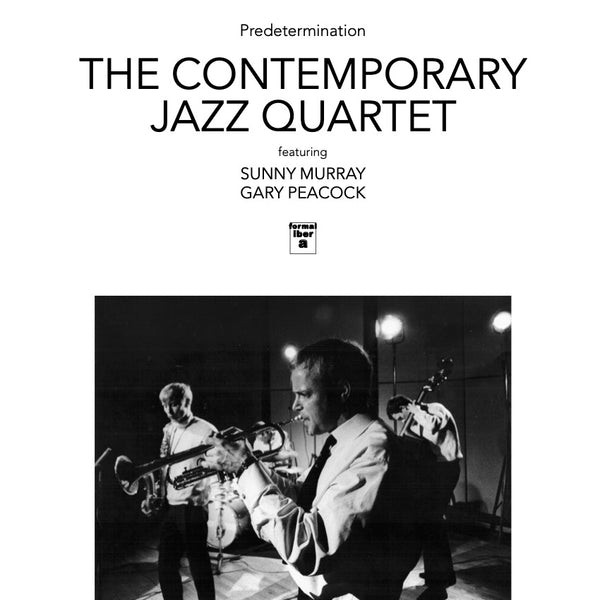
So… TCJQ together with Gary Peacock and Sunny Murray! Read that again and take a breather. This is THE sunken treasure. This is music I have only heard about. And yet, here it is. Here it fuckin is! Unbelievable. Intact. Preserved. Beaming of energy and JOY! This is a sensational find. My favorite Danes exploding together with my favorite double bass player all time. Gary Peacock. The engine. The power engine. I can hardly breathe when he plays, and when he starts soloing and creating beautiful duo bass action with his colleague Steffen Andersen in this very first recording of “Predetermination”, 10 minutes in – my heart expands, and the world suddenly looks and sounds entirely different.
Add Sunny Murray on top of it all… the master of unreal flow and accents. This shit is BURNING!!!! Sunny was a beast to deal with at the time. But what he adds to the music is pure poetry. No other drummer did anything even close to this back in the mid 60s.
To have Steinmetz and Beckerlee playing alongside Peacock and Murray in 1964 is as good as it gets. The absolute point-zero of free jazz, “Spiritual Unity”, was just released. It changed everything. This is the mother of it all. The birth. You would think Steinmetz and Beckerlee would have had a little anxiety joining the American duo. There is nothing of uncertainty or vague playing here. This is for real. Right-on-take-no-prisoners-do-not-look-back.
It is spelled i n t e r a c t I o n.
My mind implodes.
Added to the A-side of this mythical recording with creative Danes and the rhythm section of “Spiritual Unity” is a little improvised miniature. “In the Name of Beauty”. The title very accurately describes what is going on. TCJQ creating pure communal beauty. Steinmetz, Beckerlee and Andersen getting very real! Dig the harmonics of the last note.
The B-side´s “Spontaneity”, “Action” and “Collusion” are just wild. Raw. And utterly beautiful. The group is doing real sharing on a level unheard of before. While listening through this music numerous times and trying to write something simultaneously of intellectual or emotional content something happens… I loose the sense of time. I just sit with an open mouth and mind. And smile. This is music that should be played for all younger (and older) musicians with an ambition of creating any kind of radical music. No matter what genre. This is sharing. And sharing is KEY! Sharing the moment. Sharing the music. Sharing the time. Togetherness. I listen again. And i just smile. Again and again. I smile. I think that is a good sign?
The emerging free jazz scene of Denmark of the early 60s, is something spectacular and WILD. Years before the other Scandinavian countries even got a grip of the new jazz, the Danes were doing it already. Fueled by very important guest visits by Cecil Taylor, Sunny Murray and Albert Ayler at both clubs and radio or TV appearances. Those were the times when public service actually noticed new developments in art, music and literature. Denmark was a hotbed for artistic developments. A society curious of the new. The Louisiana art museum opened already in 1958 and created amazing possibilities to present the new art, and the iconic jazz club Montmartre opened up one year later. The Situationist movement with Asger Jorn and Jørgen Nash was very active with avantgarde culture and performance art around the same time. In October 1964 the members of The Contemporary Jazz Quartet were involved in the Kunstakademiets Festival Charlottenborg along with David Tudor, performing works by John Cage, Sylvano Bussotti, Michael von Biel and Toshi Ichiyanagi. In the end of 1965 Hugh Steinmetz, Franz Beckerlee and Steffen Andersen took part in many events during the Poex 65, a ten-day experimental poetry festival also involving performances by Fluxus artists Henning Christiansen, Tomas Schmidt, Eric Andersen and Arthur Køpcke, readings by Åke Hodell and Bengt af Klintberg, screening of experimental cinema as well as electronic music by Else Marie Pade. Looking in retrospective it looks like everything was possible. And a LOT was done. It was a centrifuge of creative art, fluxus fantasies, poetry and music!
Why on earth was this music not released the day after the recordings? It could have changed a lot… not only for the Scandinavian scene.
My favorite hidden music. Freeeeeee before it was set into a standard form. Before the norm was set.
Free jazz as in FREE jazz.
This sunken treasure is above the surface now. Levitating towards outer skies of human consciousness.
My favorite place.